
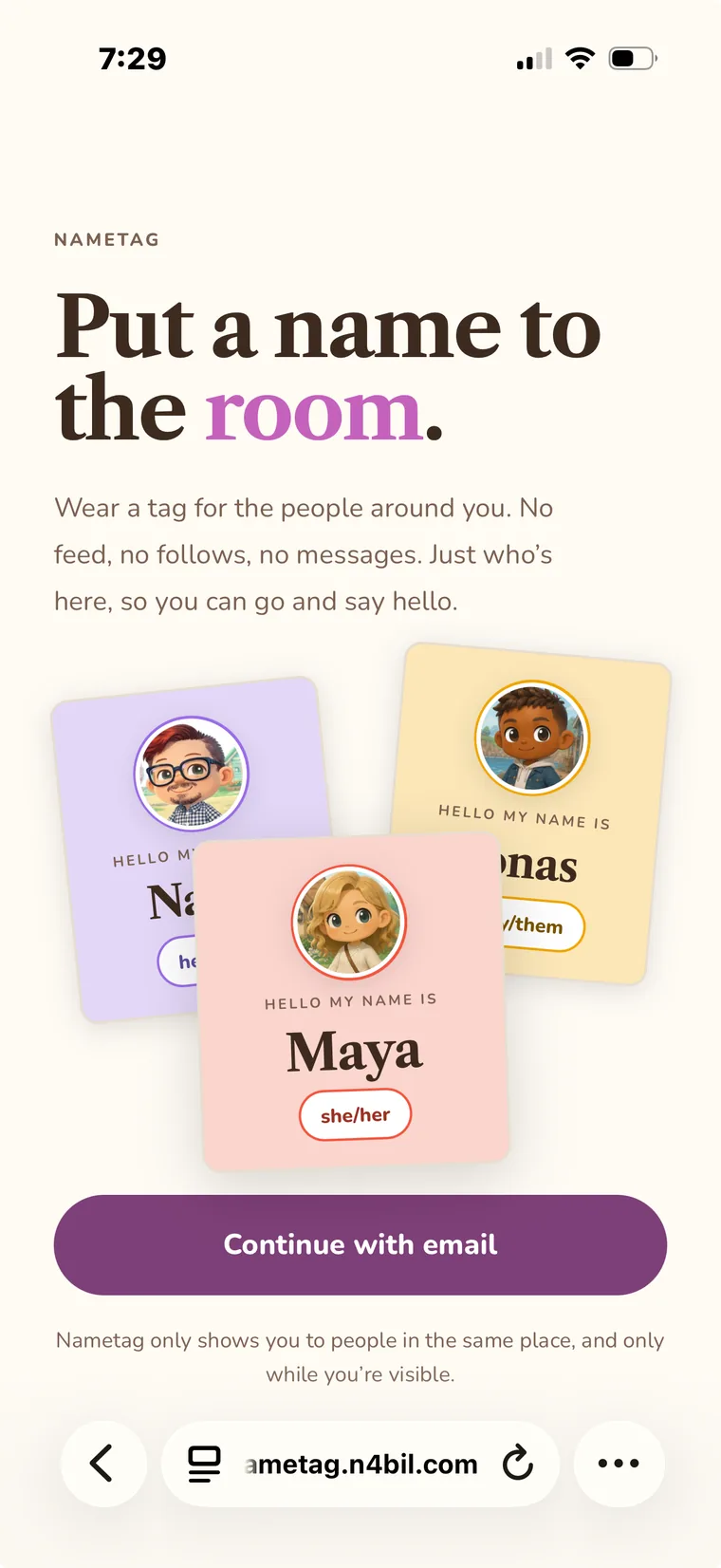
It's an early, vibe-coded prototype — a web app today, an iPhone app if it earns it. Works best on your phone, in a room with other people. Kick the tires and tell me what you think below.
Why I built it
Honestly? For a problem of my own. I'm not always great at remembering names — and pronouns — for the people around me at a party, and I wanted a graceful way to see them without the little dance of asking again. So I built the thing I wished existed, for the rooms I'm actually in.
The whole idea is the opposite of a social network. There's nothing to scroll and no one to accumulate. You wear a digital name tag for as long as you're in the room, you glance at everyone else's, and then you get up and talk to a real person. That's the entire loop.
How it works
Who's here, right now
Everyone in the room appears as a tilted "Hello, my name is" tag — face, name, pronouns, and a line about what they're up to.
No feed, no follows, no DMs
There's nothing to scroll and no one to message. The tags are a nudge to walk over and start an actual conversation.
Visible only while you choose
You appear only while you're visible, you can duck into a private party code, and your tag disappears the moment you leave.
Privacy is the point, not a setting
Because I built this for real rooms with real people, privacy is the core constraint rather than an afterthought. You're only ever visible while you choose to be, a party code keeps a gathering to just its guests, and nothing about your presence sticks around once you've left. The paper sticker you peel off at the end of the night was the whole design brief.
Tell me what you think
I'm collecting reactions before I turn this into a real iPhone app. Anything at all helps — what clicked, what confused you, what you'd actually want when you walk into a room full of strangers.